Tuesday, September 24, 2013

The fruits of Obama's Syria 'failure'

By Bob Gaydos
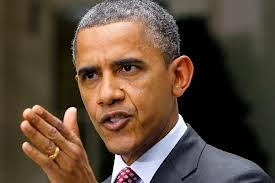
President Obama ... more to his Syria police than might appear

In the category of Things Are Never Quite the Way They Appear  (especially in international diplomacy), I give you what many “pundits” regard as President Barack Obama’s humiliating defeat in getting Syrian President Bashar Assad to: 1. Admit that his country, contrary to all his previous claims, has a stockpile of outlawed chemical weapons; 2. Agree to promptly provide an inventory of those weapons and 3. Turn the weapons over to a United Nations delegation for the purpose of destroying them all by next year..
This humanitarian feat, which will save countless thousands of lives, was accomplished without firing one missile in righteous anger or placing one set of American GI boots on the ground in the midst of Syria’s brutal civil war. Stay out of Syria is what a solid majority of Americans said they wanted ever since Obama broached the subject of a punishing strike against Syria for using chemical weapons against its own people. It is also what most Republicans in Congress insisted they wanted, contrary to their usual position on military intervention, but consistent with their policy of opposing anything Obama proposes. In this case, to the president, Republican motives didn’t matter; end results did.
This is strictly my opinion. I have no special insight into White House strategy, no one leaking me information on the president’s intentions. Rather, I have my own version of common sense and what I believe is a willingness to judge events by outcomes rather than political bias.
One of the things I believe may not necessarily be as it appears -- or as many critics would have it be -- is the president’s intent. I do not believe Barack Obama is so dumb as to submit a proposal to Congress that he wants passed if he knows it will be defeated. He is a biracial man living in a racist country who earned degrees from two Ivy League schools -- Columbia and Harvard Law, where he was editor of the Law Review. He got elected president. Twice. Having made history, he also has guided the country slowly out of a devastating, largely Republican-created recession and got a health care plan for all Americans through a Congress that can barely agree to meet. This is one smart man (although I think his “red line“ on chemical weapons was a tactical mistake).
So, I have serious doubts that the president ever intended to launch a military strike against Syria, precisely because of the opposition he knew existed among average, war-weary Americans, as well as entrenched anti-Obama, rank-and-file Republicans. He signaled that when, after days of threatening a strike, he agreed to ask Congress to debate and vote on the issue, without even asking members to cut short their vacation to do so. That made the proposal DOA, with even many Democrats opposed to U.S. involvement in Syria because of their constituents’ opposition to it.
Ironically, with the disarmament agreement now being finalized with Syria and Russia, Obama’s continued threat to use military force if Syria fails to comply with the agreement gains much more validity and support among Americans than his original threat. Assad has admitted he’s got the weapons. French, British and American experts, as well as Human Rights Watch, say, based on a United Nations report, that there is no doubt it was Assad’s troops, not rebel forces, that used them. The U.S. Navy’s continued presence in the Mediterranean Sea now takes on even greater import to Assad.
Then, of course, there is the disarmament agreement itself. Americans are strongly of two minds on this:
1. One group, that didn’t necessarily want to attack Syria, nonetheless thinks it is embarrassing that Russian President Vladimir Putin is getting credit for the plan and that he lectured Americans (in the New York Times no less) about thinking they had to act as morality policeman of the world.
2. Another group feels it is high time America stopped acting as morality policeman of the world, focused on domestic issues instead and enlisted other countries’ help in finding diplomatic, rather than military, solutions to international crises.
I don’t think Obama cares that Putin is getting most of the credit for the chemical weapons agreement. I also don’t think the agreement just sprang into Putin’s head in a dream one night. In fact, Russian officials have acknowledged such a plan was discussed months ago with American officials. Just as Obama is no clueless patsy in this, Putin is no hero. He is no champion of human rights and Americans shouldn’t really pay serious attention to what he has to say about life in the U.S.
In fact, Russia has been the main supplier of arms for the Syrian Army, enabling the civil war to drag on and produce more than 100,000 deaths and a flood of millions fleeing their country. But it is precisely for the link with Syria that Putin had to appear to be the primary force behind the non-military plan.
Of course, this helps Putin gain even more political stature at home. As mentioned previously, Obama has been elected president twice. He cannot run again. His place in history is forged and his future as a statesman guaranteed. But Putin has an Olympics coming to his country next year and has stirred worldwide condemnation for Russia’s anti-gay laws. I wouldn’t be surprised if Russian authorities were tolerant of demonstrations supporting gay rights next winter or if Barack Obama were among the world leaders being most vocal about demanding such behavior. And, while he won’t show it, I don’t think Putin will regard his apparent backing down on gay rights as a “humiliating defeat” on the international stage.
Meanwhile, a major store of chemical weapons will be destroyed, a potential threat to Middle Eastern neighbors of Syria will have been removed, rebel forces in Syria will know they don’t have to fear facing such weapons, not one American soldier will have set foot in Syria, not one Syrian citizen will have been listed as collateral damage in a strike by American “smart” missiles, the United States will have shown cynical countries that it really can use diplomacy, rather than military might, to resolve a crisis, Assad will have been shown to be a murderous liar, Putin will have had some of his Lone Ranger image stripped away in international diplomacy, President Obama, counter to his image in some corners as a reluctant warrior, will have appeared to be willing and eager to use U.S. military power, and Republicans will have emerged as a party opposed to war. By the way, the overwhelming majority of Americans support the non-military resolution of the Syrian crisis.
Humiliating defeat my ass..

bob@blogspot.com

Friday, September 6, 2013

Putin on gays: A Russian fable

By Bob Gaydos
Russian President Vladimir Putin


There’s an old Russian proverb that goes something like this: “How do you know when the president (prime minister, czar, party chief) is lying? His lips are moving.”

OK, so it’s not an old Russian proverb, but you get the gist. Today, it means if Russian President Vladimir Putin is speaking, the words emanating from his mouth are subject to change at any moment according to whatever he thinks will best suit his ultimate goal. That goal seems to be to consolidate his grip on power through whatever repressive measures he can get away with while pretending to support democratic principles of government.

So when Putin says, for example, that there is no discrimination against gays and lesbians in Russia -- despite recent passage by the Duma of a law banning any public mention of homosexuality that could be construed as propaganda supporting it -- one can assume it’s a lie. One can further assume that he thinks he has a good reason for making what common sense declares to be a bunch of bull.

That reason, of course, is the looming presence of the 2014 Winter Olympics in the Russian resort city of Sochi and Putin‘s desire to avoid a boycott of the games and/or worldwide condemnation of the Russian law and measures that might be taken to register protest against it. There are hundreds of millions of rubles at stake and Russia can ill afford to lose any of them. So don’t worry, folks, in keeping with the Olympic spirit that forbids discrimination of any kind, there will be no discrimination against gays and lesbians in Russia during the Olympics, Putin says,

Afterwards? Well, that’s another matter.

And that’s what needs to be remembered. In Russia, Putin faces no serious challenge to his words from a free, vigorous press (he’s worked hard at squelching that) and, in this case, most likely has the support of a majority of Russians. In a country with a poor history of tolerance for minorities, few are going to point out any inconsistencies between his words and actions regarding homosexuality in Russia, during and after the Olympics.

President Obama, angry that Putin granted temporary asylum in Russia to Edwin Snowden, who made public voluminous files on the U.S. government’s efforts to spy on ordinary Americans and also upset that Putin has resisted taking military action against Syria for use of chemical weapons against its own people, canceled a meeting with Putin in Russia during this week’s G20 summit. Instead, Obama met with gay activists in Russia, a double insult.

No sweat for Putin. He softened his stance on Syria and said some of his favorite Russians --Tchaikovsky, for example -- were homosexuals and yet are still loved by Russians. Whatever suits his need at the time, the former KGB chief will say, usually with a smile.

The anti-gay law has led to calls to boycott the Sochi Games, but such actions always hurt far more than their intended target. In this case, thousands of athletes -- including countless gay athletes -- who have worked for four years for this honor would be denied what for many is a once-in-a-lifetime opportunity.

Gary Kasparov, former world chess champion and an outspoken Russian critic of Putin, says there are other ways to protest. In an interview with Huffington Post, he says the protest are not about the athletes, but rather “about Putin and his repressive regime.” He says world leaders (presidents, diplomats, royalty, etc.) should boycott the games, denying Putin their implied support for his policies and perhaps weakening his resolve to pursue similar ones.

Kasparov also thinks Olympic sponsors such as Coke, McDonald’s, Visa and other major companies should recognize the views of their main customers and express opposition to the Russian law by adorning their products with rainbow flags or other symbols of support for gays. And he says NBC and other broadcasters of the Games should use their freedom and their platform to do stories about, not only the anti-gay law, but other repressive measures taken by Putin. A little press freedom in Russia would not be such a bad idea.

Admittedly, a boycott of the games would be dramatic, but would likely only stiffen Putin’s us-against-the-world resolve and not sway Russian citizens, a difficult task under any circumstances. Moving the games from Sochi (now under martial law) is impractical given time constraints. That leaves broad public condemnation of Putin and education of the Russian public -- by previously mentioned means and the use of social media -- as the most effective way to make Putin eat his words. It may also wake up the Russians and make him less likely to pursue future oppressive measures.

There’s another old Russian proverb. Something about sleeping dogs and lying. OK, it’s not Russian, but you get the gist.

bobgaydos.blogspot.com

Monday, August 19, 2013

We've become a nation of us vs. them

By Bob Gaydos
A scene from the movie, "Fruitvale Station."
I saw the movie “Fruitvale Station” the other day. I wept at the end. Real tears, not just some glistening in the eyes. This, even though I knew what was going to happen because we’re told at the beginning of the movie.
This tells me a couple of things:
-- The director did a terrific job of story-telling.
-- I felt strongly about something going on in the movie.
As for the movie itself, I am apparently not alone in my opinion. The independent film by first-time director Ryan Coogler is receiving rave reviews and awards even though it has only been recently released. Still, I was surprised at my strong, personal reaction to the film.
I probably shouldn’t have been. The reason I saw the movie in the first place is that my oldest son, Max, recommended I go. He doesn’t do that a lot. I “should” see it, he texted me. Not the usual Hollywood movie, he said. Yes and yes.
But there was also a personal connection for Max and me with the movie. It is based on a true event -- the arrest and fatal shooting of an unarmed young man by police in Oakland on New Year’s Day, 2009. Max had been arrested by police in Oakland during the Occupy demonstrations in 2011. Police response to the Occupy demonstrators -- unarmed save for cell phones and cameras -- was also violent. Their civil disobedience was met with tear gas grenades, flash bang grenades, rubber bullets -- fired at the demonstrators, not in the air. Civilians were hurt, thrown in jail, treated like criminals because someone decided they represented a threat. A threat just like the young black males apparently represented to the white police officers who hauled them off a BART train for fighting, ignoring the white males who started the fight.
In Oakland, the shooting victim, Oscar Grant, and his friends fit a profile -- young, black males, argumentative and not meekly complying with police orders to lie down with their hands behind their backs. Trouble. The same with Occupy demonstrators. Trouble. Even though they were demonstrating against injustices in society that affect police as much as the rest of us.
There has been a disturbing trend in cities across the country in recent years to respond to peaceful civil disobedience, such as the Occupy movement, with military style tactics, as if the demonstrators were an invading army rather than neighbors, friends and family members of the police themselves. I don’t know where this profiling of Occupy demonstrators came from, but it seems unlikely to have happened simultaneously in so many places at the same time. Some federal agency had to have decreed the demonstrators fit a profile of trouble makers -- potential domestic terrorists even -- who had to be quashed, rather than Americans citizens exercising their constitutional rights to assemble and voice their opinions. What’s really disturbing to me is how everyone down the line from that profiling decision seemed to accept it rather than to judge the demonstrators on their own.
I am not anti-police. Far from it. I believe a well-trained, appropriately armed police force is essential to maintain order. I do not believe most local police forces need big, armored vehicles to handle peaceful demonstrations. I do believe much more training on dealing with people in emotionally charged situations, rather than with weapons, would be a major benefit to all police departments.
Mostly, I believe that when there is no threat of force from the subjects involved, police should be trained to resist the tendency to make it a situation of us versus them. We are you. You are us. Oscar Grant was someone’s son, someone’s father, someone’s partner. He was a human being. He had done jail time for selling marijuana. He had been fired from his job. And he was apparently struggling to overcome the profiles that said this was his lot in life.
Yes, the profile said he had to project a certain arrogance in order to survive, but he was only out to celebrate New Year’s Eve with friends and wound up shot dead by a white transit cop who said he mistook his gun for his Taser. The cop was convicted of unintentional manslaughter, served 11 months of a two-year sentence. In Oakland, with its long history of out-of-control police response. Grant’s death sparked demonstrations, including one every New Year’s Day at Fruitvale Station.
There are stories similar to Oscar Grant’s in cities across the country. The film was released during the Trayvon Martin trial in Florida. The day I saw the film, a federal judge in New York City ruled the police force’s program of stop-and-frisk was unconstitutional because of obvious racial profiling -- a welcome wakeup call only if city officials hear it.
This being a movie, there are things that were added, or left out, that might affect someone’s opinion of it. I get that. For many there will be a strong message of injustice still to be rectified. Yet others may see it as a shameless effort to manipulate anti-police sentiment. I’ll keep it simple. In Oakland, in 2009, a cop shot an unarmed, handcuffed, 22-year-old black male to death. Shouldn’t have happened. In Oakland in 2011, cops fired tear gas, flash bang grenades and rubber bullets at, among others, my son Max, then 19. He was armed with only a camera. They handcuffed and arrested him. Max is not black. He’s alive and well. But if one cop can mistake his gun for his Taser, why can’t another one mistake real bullets for rubber?
I wept for Oscar and Max and because we have become a nation of us versus them. Go see the movie.

Friday, July 19, 2013

Bill and Lois ... nothing more need be said


(My latest Addiction and Recovery column.)

By Bob Gaydos
Stepping Stones, the home of Bill and Lois Wilson,
 in Katonah. IR Photography.

Bill and Lois. Mention those names to members of Alcoholics Anonymous and Al-. Anon and nothing more need be said. They are the founders, the driving forces behind the 12-step programs that have helped so many people to recover from alcoholism.
Wilson is their last name, but he is best known as Bill W. and she as just Lois, perhaps the only woman in the world who could have lived with him during years of alcoholic behavior and stuck with him through the ensuing years of the creation and growth of AA into a worldwide program of recovery. At Bill’s urging, Lois later organized what was a loose collection of groups of people struggling with the effects of  others’ alcoholism into what today is the worldwide Al-Anon Family Groups.
As partnerships go, theirs succeeded beyond what any conventional wisdom might have predicted. And while it’s true that there are no gurus in the AA model of recovery, make no mistake about it, Bill and Lois are special people to those who seek help from the two programs. Together, they lived through the pain of alcoholism and created the mold millions have adopted for escaping its grip.
One of the ways in which that special regard is demonstrated is the thousands of visitors yearly to Stepping Stones, the Wilsons’ home in Katonah, in Westchester County. The large, comfortable home and well-kept gardens that occupy eight acres exude the peace and serenity to which members of AA and Al-Anon aspire.
Not that it was always so. When Bill and Lois first moved to Katonah from 182 Clinton St. in Brooklyn, their new home (they moved 51 times) became the destination of choice for people desperate for an answer to their drinking problem. There was seemingly always someone (or more than one) being 12-stepped by Bill in the living room (Bill kept alcohol on hand for those who needed detoxing), or just having impromptu AA meetings. The coffee pot in the small kitchen was meant for large gatherings. As Joe D., a 29-years-sober guide at Stepping Stones, puts it, “We think of Clinton Street and Stepping Stones as the first rehabs.”
The house also had the feel of a hotel, since AA friends were always on hand, helping to produce literature to spread the word on the recovery program or to sit and listen to Lois play the piano while Bill played the fiddle. On occasion, friends would join them in the “ghost room” where the ouija board was located.
It got so busy in Katonah that Bill eventually had a writing studio built up the hill from the bustling house so he could get some quiet to write “Alcoholics Anonymous,” better known as “the Big Book,” and other books detailing the AA path to sobriety.
The home and studio are part of a 90-minute tour given Monday to Saturday at 1 p.m. The tour is informative, but can’t possibly encompass the magnitude of the writings, photos, letters, books, art work, gifts, newspaper articles and personal mementos that Lois kept and organized. “Lois saved everything but Bill’s clothes,” Joe says. The Stepping Stones Foundation has archived all of this and now presents it at the national historic site as a history of the lives of Bill, Lois, AA and Al-Anon. Visitors are free to peruse the collection as it suits their curiosity. Return visits are not uncommon.
On a recent week day, a couple from Brooklyn took the tour. Kate, three years sober, said, “It’s amazing to be up here,“ She was impressed with how “selfless’’ Bill and Lois were and “how much of their lives they dedicated to helping others get sober.”
Her companion, Tim, 28 months sober, said there were a couple of things they could have done that day, but he was glad they chose to visit Stepping Stones, among other reasons because he learned that “Lois was a major person” in the history of AA as well as Al-Anon.
Another visitor, M., from Sullivan County, with four-plus years in Al-Anon, said, “I came to see Lois’ legacy because she’s basically my hero. Notwithstanding the fullness and complexity of her own life, it was enlightening to discover how much of herself was consumed by standing in the way of Bill and his next drink.” Of  Stepping Stones, M. said, “It’s nothing short of magnificent the way it has been preserved.”
That’s true. And it’s more than just a home that has been preserved. It’s an idea, a legacy, a way of life, a unique pairing that brought hope to millions of people and, indeed, changed history in the process. All of that is what keeps people coming to Stepping Stones.

If you go …
A Bill and Lois commemorative coin, available in the gift shop.
                                                                            IR Photography
Stepping Stones is located at 62 Oak Road, Katonah. It is open Monday through Saturday, from noon to 3 p.m. Tours lasting roughly 90 minutes start shortly after 1 p.m. and it is suggested that you call ahead or e-mail to reserve a spot.
 The buildings are air-conditioned. There is a small gift shop. A donation of at least $10 per person is suggested.
 The phone number is (914) 234-4822; e-mail: info@steppingstones.org. For more information on the site, including directions, the web site is www.steppingstones.org.

Tuesday, July 16, 2013

Warning: This column may be bugged

By Bob Gaydos

Hi there. Thanks for clicking on this article. I feel obliged to warn you right off that you and I are probably not alone in this seemingly intimate connection. Odds are this interchange is being monitored by some government or private computer for the purpose of, well, maybe for the sole purpose of demonstrating that it can be done.
And it is done, routinely, to anyone and everyone who uses a computer, lap top, tablet or cell phone. Privacy has become a quaint concept, an anachronism, in the computer era. The very tool that has freed us to a world of instant information and communication has also stripped us of something we cherish, our privacy.
Let me amend that. The tool is not to blame. It’s the people using it. They have entered our lives -- admittedly often at our initial invitation -- to such an extent that savvy technicians can put together accurate profiles of us in short order. Mostly, these people work for private companies that want to sell us something based on our computer behavior. Of course, those with malice in their heart can and do use their skills and the gathered data for  purposes such as identity theft or simply installing a computer virus for no apparent reason.
This is not news to you, I’m sure. What’s perhaps new and most troubling to me is the extent to which our own government is involved in spying on us. Recent revelations by Edward Snowden of a massive cell phone data collection program run by the National Security Agency targeting average American citizens has been followed up with revelations of the extent to which the NSA also has used popular Internet service providers such as Microsoft, Google, Yahoo, Bing, AOL, Apple, Facebook and YouTube, to compile information on private citizens.
Why?
Why national security, of course. There could very well be potential terrorists lurking out there among those cute cat photos and it is part of our eternal war on terrorism to try to find them among the billions of clicks per day on computers.
That’s the company line and there is a small element of truth in it. But we can’t assess how valuable the snooping has been because the government (the White House and Congress) won’t tell us anything that can be verified by uninvolved parties. (And the head of the CIA lies to Congress without getting fired.)
Mostly, though, I have come to believe (and this is why I warn you this column may be bugged) that our government snoops do this kind of thing because they can and they really don’t see it is an invasion of privacy and most certainly do not consider the massive potential for abuse it presents. This is scary. When the computer spies forget that they, too, are American citizens and also suffer from any erosion of individual privacy along with the rest of us, the slippery slope to total control of the citizenry has begun. Life, liberty and the pursuit of happiness lose their meaning.
Too alarmist?
Well, consider the reaction of President Obama when Snowden  subsequently revealed that the United States was snooping on countries in the European Union and elsewhere. These are our friends, mind, our allies. The EU folks erupted with indignant surprise. They were outraged, etc. Obama said, in effect, what’s the big deal? Everybody does it.
Which is in large part true. The EU huffing and puffing was largely for show. They knew they were bugged and some of them also bugged official United States locations for the purpose of … what?
The nonchalant nature of the practice on an international scale bespeaks an inability and/or unwillingness to trust friends at their word or to get some kind of edge on them in international diplomacy. So I ask, why would this attitude not translate into domestic spying? It’s no big deal. Everybody does it. National security, you know? Trust us, we mean you no harm.
Really? Well then, why is the entire process sealed in secrecy, with a special court granting rubber stamp warrants for the government bugging private citizens? Why is the court answerable to no one in the public? Why are its rulings free from challenge? Why are private contractors (Snowden was one), not actual government employees, given access to such highly classified information? What happens to the data collected on U.S. citizens who turn out to be really just “average” Americans connecting with friends or venting frustration on Facebook? Why are most of our political leaders focusing on Snowden’s release of “classified” data rather than on the enormity of the spying effort on private citizens?
And why should we not be concerned that instructions are available on line on how to turn computer cameras (yes, Skype, too) and cell phone cameras into devices that can spy on their owners, a weapon that obviously could be used by serious government computer spies? And probably is. (Put tape over the lens without actually touching it. Shut it off in the bedroom.)
We “average citizens” have definitely been complicit in creating this situation, but most of were also a bit naïve: I have nothing to hide, so why should I worry about putting personal information on line? That may have been a valid view at one time, but it ignored the reality that those with a certain amount of power inevitably seek to expand their power and control.
Our government is supposed to protect us from this. When it is the offending party, we need to challenge it. We have no choice. We must do this peaceably, but vigorously, through public demonstrations (as the Occupy movement tried), petitions, messages to elected officials, support for candidates who want to shine light on such programs and eliminate abuses, rejection of candidates who support the spying, protests to and boycotts of companies that cooperate with spying efforts, And by voicing opinions of protest on line.
Which is where I came in. Thanks for reading this. Don’t bother deleting; Big Brother already knows you were here.

Wednesday, July 3, 2013

The game is rigged; it's time to revolt

By Bob Gaydos
Edward Snowden, currently on the run and accused of being a spy, did more than reveal how much snooping our government does on its own citizens. For me, he provided a smack upside the head and a wakeup call to something I’ve believed for a long time but, being a bit lazy and self-absorbed, had dispatched to a dusty, unexercised corner of my brain.
Edward Snowden
         To wit: The game is rigged. Put another way: “Dysfunction” has a function.
Consider this: With Congress’ approval rating at historic lows, with Republicans rejecting out of hand every proposal put forth by Democratic President Barack Obama, with a Democrat-controlled Senate unable to pass meaningful legislation because of archaic filibuster rules used by Republicans, with both major political parties staking out rigid positions on opposite sides of every issue, what is the one thing on which Republicans and Democrats suddenly agree? That Edward Snowden is a traitor.
That is the Edward Snowden who blew the whistle on the most sweeping, secret domestic spying operation ever conducted by an American government on its people. It is an invasion of privacy condoned -- and now vigorously defended -- by both political parties as necessary for the security of the people being spied upon. Yes, the politicians also read George Orwell. But they’ve been caught with their “bad-is-good” pants down and have demonstrated that, when their power is in jeopardy, they can find true harmony. All together now: Snowden is a traitor.
The threat to the power brokers, of course, is that a lot of Americans will awaken from their self-absorbed delusion that their elected representatives are actually trying to do something positive for their constituents, as opposed to the reality they are doing whatever is necessary to maintain their membership in the power elite. That’s the 1 percent who reap the fruits of the manufactured dysfunction.
Look at it this way: Democrats talk about jobs, immigration, education, the minimum wage, etc. Republicans talk about abortion, guns, rape, gay marriage, etc. The parties bicker and banter and do next to nothing  about any of those issues. Dysfunction. Or so it seems.
But they also ignore issues that would actually fix much of the apparent dysfunction -- campaign finance reform and revising the filibuster rules, for two.
It’s planned dysfunction.  You keep your talking points; we’ll keep ours. We’ll all get re-elected anyway or, if not, move on to even more-lucrative lobbying jobs, book tours, top corporate positions or TV punditry. Rigged.
And it’s not just Congress. Having plunged the world into the worst financial crisis since the Great Depression, American banks and investment firms (which used to be separate entities) are now reaping the profits of their plundering of other people’s wealth, thanks to a government bailout and the failure of the political powers that be -- who reap substantial campaign contributions from these financial institutions -- to send any of the bankers to jail.
In the sequel to “Wall Street,” arch-villain Gordon Gekko says he was convicted of a “victimless crime,” as if no lives are negatively affected when companies go under because of shady, immoral behavior by financial companies.
At least Gekko went to prison for his misdeeds. But then, that was in the movies and even his creator, Oliver Stone, tries to find some redeeming traits in his main character in the sequel. Meanwhile, in real life, no one can make any money today putting money in banks and, as Gekko also points out in the sequel, the task of investing money in the stock markets, where profits may be made, has been made so complex, only “about 75 people in the world understand it.”
That may be an exaggeration, but not by much. Most of us need to trust the very people who have proven to be untrustworthy with our money to make investments.
There are other dots to connect, but for now I’ll limit it to major corporations that move top executives to influential government positions and back again, getting laws written to their liking (often by their own former employees), usually without a whimper from members of Congress. Think Monsanto and Halliburton.
Corporations pour tens of millions of dollars into political campaigns hoping to elect candidates who will then return the favor by promoting legislation that will improve corporate profits or opposing proposals placing restrictions on corporate power. The latter would include the public’s right to sue and to obtain information on corporate practices. This is serving the private, not the public, good. It’s part of the system.
Now, this rigging did not occur in a vacuum. There had to be at least an implicit acknowledgement from the rest of us that what the people to whom we had entrusted power and position was doing was right and proper for all of us. That may have simply come in the form of apathy or blissful ignorance. Don’t bother to vote. Don’t try to understand the issues. Hey, life is already too busy and complicated without such things.
But not for those whose motivation is accumulating more wealth and power. For them, an important part of the rigged system is making it seem so complicated and out of our control that it is impossible to change. That’s not necessarily true. There are people, even politicians, who recognize that things have been rigged for a powerful elite and who speak out regularly about it. Sens. Bernie Sanders and Elizabeth Warren and Rep. Jim Moran are three of the most outspoken. They need allies and support, vocal and financial.
So do the Internet activists campaigning for campaign finance reform and greater transparency in government and Wall Street. These are not obscure issues that don’t impact us. Indeed, they are crucial to ending the grip of the 1 percent on our national wealth and positions of power.
There are some simple steps that can be taken by individuals, groups, towns to begin to reclaim some control over our lives. Registering to vote and actually voting is a start. Getting informed on the issues that matter and working to raise awareness (think the Occupy movement and social media) is another. The movement to sustainability and buying locally grown food, as opposed to that offered by corporate growers, are not just “feel-good” green ideas. Like using alternative energy, they challenge the influence of large corporations (and they don’t come more influential than oil companies) and give people some control over their lives. People have even started turning their lawns into vegetable gardens. Seattle is planning the nation’s first public food garden. Take a walk, pick an apple. Eat it.
Some of this may sound simplistic and even ineffectual in the face of such entrenched power and wealth, but all revolutions have to start somehow. And make no mistake, nothing less than an all-out revolution will serve to unrig the system and dislodge those who thrive within it. Some noise must be made. The alternative is to do what many of us have been doing for a long time -- complain that “they’re all crooked, so what’s the use?”
Some people are comparing Edward Snowden to Paul Revere. I won’t go that far yet. There’s too much information still unknown (and yes, the mainstream media stands suspect as being part of the system). But I’m not ready to call Snowden a traitor either, not when Republicans and Democrats somehow manage to agree that he is. That smells too much like the fix is in.

bobgaydos.blogspot.com


Wednesday, June 5, 2013

Growing up in an alcoholic home leaves unseen scars

By Bob Gaydos

(My latest Addiction and Recovery column.)
       In writing about alcoholism, this column usually focuses on the person most directly affected by the disease -- the alcoholic. But the impact of alcoholism is felt by every person with whom the alcoholic comes into contact and that begins with the immediate family. In fact, some of the persons most seriously affected by the disease of alcoholism are children who grow up in an alcoholic household. Indeed, these households give a whole new meaning and depth to the term “dysfunctional.”
Growing up in a family with one parent who is an alcoholic and the other struggling to maintain some sense of order, if not sanity, can leave scars that last well into adulthood. Worse, the children who grow up in such households may not realize how ill-prepared they are to deal with life. And that’s whether they become alcoholics themselves or not.
Often, the non-alcoholic parent tries to shield children from the truth, as if they cannot see and hear what is going on every day in their home.  Much better, experts say, to be as honest as  possible with them, explaining the disease as an allergy to alcohol, that the drinking parent is sick and, most importantly, that the children -- who may feel violent effects of the alcoholic’s drinking -- are not at fault. Sometimes, the non-alcoholic parent is so consumed with trying to control the alcoholic, that the children become an after-thought, even neglected.
Either way, the emotional support and daily guidance needed to help young people make their way through an adult world later on is often missing. This lack of early guidance can show up in many ways as the children of such marriages, modeling their behavior on what they grew up with at home, find themselves unsure and unable to deal with life as it comes along -- and find themselves at a loss as to why.
As mentioned here before, the Al-Anon Family Groups, which includes Alateen for young people, is uniquely designed to help those who are living with an active alcoholic. This is not just the spouse of an alcoholic, but the entire family. For the non-alcoholic spouse, learning to separate the drinking spouse from the disease and recognizing that alcoholism has impacted you as well is the beginning of a long recovery process that can lead to a healthier, more well-adjusted life.
So, too, for the children. But it is important for the children of such households to keep tabs as adults on how they treat their own children. Do they mimic what they grew up with or do they use healthier, more balanced approaches? To this end, an Al-Anon booklet -- “How Can I help My Children?” -- offers a checklist for parents. In truth, it’s one that should prove useful to all parents, of any background:

  • Do I think of my children as people who a right to my respect?
  • Do I make them feel stupid, inadequate or bad?
  • Do I humiliate them in front of others? Or do I correct them privately, allowing them to maintain their dignity?
  • Am I courteous to my child?
  • Do I habitually yell? Threaten? Nag?
  • How do I correct my children? Do I attack their character, call them names? Lose my self-control? Hit them? Make sarcastic remarks? Ridicule them?
  • Do I jump to conclusions, expecting the worst, or do I give the a chance to tell their side?
  • Do I make a big issue over small things?
  • Do I let them know they are important?
  • Do I apologize when I am wrong?
  • Do I set limits on behavior and enforce them?
  • Do I show my children affection and tell them I love them?

For a list of Al-anon and Alateen meetings in the area, go to:
     http://www.al-anonny.org/images/Orange_County_Meeting_List_Jan_2012_B.pdf

bobgaydos.blogspot.com