Wednesday, September 2, 2015

The GOP turns back the clock on women

By Bob Gaydos
Donald Trump, "debating."

     North Korea announced recently that it was moving its clocks back 30 minutes, thereby creating its own time zone a half hour behind Japan and South Korea, for whom North Korea has no love. 
    Not to be outdone, the Republican Party in the UnIted States revealed that it was turning its clocks back 60 or 70 years, creating a world in which women’s lives, health -- indeed their very dignity as human beings -- does not matter if it means losing votes in the party’s presidential primaries.
     Since North Korea has never really left the Cold War era, the world will survive its time change with little inconvenience. It is not so easy, however, to dismiss what is happening with the Republican Party. Never mind Lincoln, this is no longer even the party of Eisenhower, Reagan or Bush the senior.
     What was billed as a presidential debate, turned out to be an all-out misogynistic effort to cast women as second-class citizens, or less. Donald Trump, who has made himself the mouth and face of today’s Republican Party, has received much of the post-debate criticism for his crude remarks about women in general and debate moderator Megyn Kelly in particular.
     Kelly dared to question Trump about his at various times calling women “fat pigs, dogs, slobs and disgusting animals” and wondering what a women contestant on his TV show, “The Apprentice,” would “look like on her knees.” Kelly asked him if this was the kind of person who should be sitting in the Oval Office. He replied that he had no time for “political correctness.’’
      After the debate, Trump called Kelly a “bimbo” on Twitter, saying she “behaved very badly” and some of her questions “were not nice.” He also said in a post-debate interview, “You could see there was blood coming out of her eyes, blood coming out her wherever.” 
     This, of course, is Trump and, predictably, he does not apologize for anything he said. He mistakes common decency for political correctness. He is a bully and an embarrassment as a presidential candidate for a major party, but an embarrassment created by the very Fox News network for whom Kelly works. And he gets applause and laughs from Republican audiences who come to hear him say what many of them apparently believe.
       But not one of the other nine men on stage with Trump on Thursday saw fit to call him out for being a sexist pig. In fact, most of them had their own fuel to add to the anti-female furor. There was Sen. Marco Rubio insisting that women who were rape or incest victims should carry their pregnancies to term and Gov. Scott Walker refusing to make an exception on abortion if the woman’s life were at risk. Even after the debate, not one of the 16 other Republican candidates for president could simply say straight out that Trump’s remarks were crude, offensive, or, at the very least, inappropriate.
      Even the lone female candidate, Carly Fiorina, relegated to the junior varsity debate of seven candidates that preceded the main event, couldn’t call Trump out by name. She only managed to say, “It’s not helpful to call people names” or “engage in personal insult.” Fiorina is a graduate of Stanford, Maryland and MIT and ran Hewlett Packard for six years. If Trump were one of her executives at HP and said the things he has said about women, you can believe he would have heard, “You’re fired!” loud and clear. But she’s running for president as a Republican and so she apparently feels she can’t afford to insult the people who show up to listen to Trump say whatever comes into his mind. By the way, she also opposes paid maternity leave.
       There’s more. There’s Jeb Bush insisting that the federal government spends too much money on women’s health care and the willingness of several GOP candidates to shut down the federal government to avoid funding for Planned Parenthood, which is a vital source of health care for millions of women and, although attacked routinely by Republicans as a source of abortions, is, in fact, a major force for reducing the number of abortions.
       Some Republican “strategists” say the media focus on Trump and his penchant for insulting large groups of people (Mexican immigrants are “rapists and murderers,” Sen. John McCain is “no war hero” because he was captured), will not do any lasting harm to the party because Trump will not win the nomination. That is absurd.
       Whether he is the eventual candidate or not, Trump has already shown the GOP for what it is -- a party driven by fear. There is a pathological fear of offending the ultra-conservative, white, mostly male, “Christian” moralists who threaten to reject any Republican candidate who does not share their fears of people who are different from them, be they non-white, gay, non-Christian, young, immigrant, or even a president of the United States who happens to be black.
        Now, it’s women. More than half the population of the country. Without strong support from women, no candidate can be elected president. In every presidential election since 1988, women have supported the Democratic candidate. Yet not one Republican candidate for president this year has something to offer females as a reason for deserving their votes. It is a cavalcade of clowns (Trump, Rick Perry, Ted Cruz, Ben Carson, Bobby Jindal), con men (Mike Huckabee, Rand Paul), bullies (Chris Christie), religious zealots (Rick Santorum), phonies in the pocket of PACS (Bush, Walker, Rubio) and fear-mongers (too many to list).
        North Korea changed its time zone because it hates Japan. However impractical the move, it won’t do serious harm and North Korea actually has some history to help justify it (World War II). Why Republicans are behaving as if they hate women is incomprehensible and possibly suicidal. And they can’t blame it all on Donald Trump.

bobgaydos.blogspot.com


Tuesday, September 1, 2015

E-cigs: Way to quit smoking or new way to get hooked?

Addiction and Recovery
By Bob Gaydos

Is it a Catch-22 or a smoke screen? Are e-cigarettes the most promising product to come along to help smokers quit their nicotine addiction, or are they a clever, new way to get non-smokers hooked? Or, are they both?
At this point, no one can say for sure, but there appears to be an informal and growing consensus that electronic cigarettes represent a real health benefit for longtime smokers. That’s because e-cigs do not contain tobacco and the many harmful substances that are released and inhaled when cigarettes are smoked. At the same time, there is concern that too little is known about possible negative health effects on e-cig users and bystanders of chemicals that are released when their vapor is inhaled.
That is an important health issue, but the purpose of this column is to discuss addiction. In that regard, again because of the newness of the product, there is too little information to know if e-cigs, as widely touted, can actually help smokers break their nicotine addiction. Even more significantly, as the Food and Drug Administration says on its web site, “It is not known whether e-cigarettes may lead young people to try other tobacco products, including conventional cigarettes, which are known to cause disease and lead to premature death.”


As public health campaigns against tobacco products have
sharply reduced sales of tobacco products in the United States, e-cigarettes have quickly blossomed into a $2-plus billion industry that shows no signs of slowing down.
Cities and states have scrambled to pass laws regulating where e-cigs can be used. New York City bans using them wherever smoking is banned. (You must be 18 to buy them.) In an effort to provide uniformity to the law, the FDA is poised to extend some or all of its regulations for tobacco products to electronic cigarettes. That has a lot of smokers upset, saying the government shouldn’t make it harder for people trying to quit smoking by vaping -- the term for using e-cigarettes.
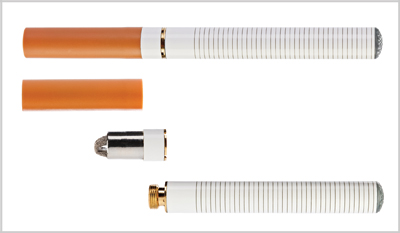
E-cigs use a battery to heat and vaporize nicotine that is mixed with water, flavoring and a base (two types) to carry the mixture. Unlike traditional cigarettes, cigars and pipes, there is no combustion -- the source for the health problems. For e-cig users, it’s more like inhaling fog, with a shot of nicotine (in varying doses), while enjoying the same hand-to-mouth, tactile experience of lighting up. Smoking without the smoke.
Again, that sounds like a sensible way to help longtime smokers avoid the serious health risks associated with using combustible cigarettes, while still getting their nicotine fix. It says nothing about that fix -- the addiction to nicotine. Some studies have raised concerns about the addictive power of the nicotine used in e-cigs, even at lower doses.
Meanwhile, many anti-smoking groups and health experts pose this question: If e-cigarettes are being sold as a way to reduce the harm of smoking tobacco for longtime smokers, why are they also being marketed in such a way as to attract thousands of young users who have never smoked traditional cigarettes? (It is worth noting that big tobacco companies are also big sellers of e-cigarettes.)
The fear, cited by the FDA as well as public health advocates, is that electronic cigarettes may act as a gateway product, luring young users into trying tobacco products.
A recent report in the Journal of the American Medical Association lends weight to that fear. The report noted that, in a recent study, 16 percent of 10th-graders reported using e-cigarettes. The study said that the group of teenagers included those who had smoked before (43 percent) and those who had not and that, in follow-up studies, the teens who had never smoked before were more likely to try smoking traditional cigarettes after trying e-cigs. Curiosity? Suggestibility? Peer pressure? Being a teenager?
Among those who suffer from it and those who treat it, there’s a saying: Addiction is a disease of more. In other words, if I can feel this good with just a little nicotine, how good can I feel with even more? Or, if this is such a cool experience -- making believe I’m smoking even though I’m not inhaling any nicotine -- how cool can it be with the real thing?
Sukhwinder Singh and his wife, Satnam Kaur, own Smokers Heaven, an e-cigarette shop in the Town of Wallkill in upstate New York. He says 75 percent of his customers are trying to quit smoking. “They’re trying to go from smoking thousands of chemicals, to one, nicotine.” He says many have been advised by their doctors to switch to e-cigs.
Singh says he only sells flavorings made in the United States (not China) because there are more controls on the ingredients, another concern for the FDA. “I don’t push nicotine on anyone,” he adds, saying that he tries to steer younger non-smokers who are curious about the product to non-nicotine mixtures. He and his wife sample the choices of hundreds of appetizing-sounding flavors -- without nicotine -- so they can tell their customers what they are like.
The fact that e-cigs are also cheaper than combustible cigarettes -- many more puffs per buck -- adds to the argument that they are a sensible, harm-reduction, health product.  But the FDA says there is as yet no proof of that. If they came under FDA control, e-cig makers would have to pass scientific muster to gain approval for sale. That could be expensive and time-consuming.
But even if producers eventually do offer scientific evidence of harm reduction, e-cigs are still delivery devices for a highly addictive substance -- nicotine. For this reason, the FDA is being urged, at the very least, to make e-cigarettes subject to the same regulations that prohibit companies from advertising and marketing tobacco products in ways designed to appeal to young consumers.
Are e-cigs safer for some? Maybe so. Time will tell. But even time won’t erase one question: If there’s no addiction to quit (no harm to reduce), why risk creating one?


E-cigarettes and the FDA
Electronic cigarettes, also known as e-cigarettes, are battery-operated products designed to deliver nicotine, flavor and other chemicals. They turn chemicals, including highly addictive nicotine, into an aerosol that is inhaled by the user. Most e-cigarettes are manufactured to look like conventional cigarettes, cigars, or pipes. Some resemble everyday items such as pens and USB memory sticks.
Only e-cigarettes that are marketed for therapeutic purposes are currently regulated by the FDA Center for Drug Evaluation and Research. Currently, the FDA Center for Tobacco Products regulates cigarettes, cigarette tobacco, roll-your-own tobacco and smokeless tobacco.
FDA has issued a proposed rule that would extend the agency’s tobacco authority to cover additional products that meet the legal definition of a tobacco product, such as e-cigarettes.

http://www.fda.gov/NewsEvents/PublicHealthFocus/ucm172906.htm


Wednesday, August 12, 2015

So, what does it mean to be labeled 'organic'?

The Healthy Shopper

By Bob Gaydos
Illustration of the USDA organic sealThe most important information on food product labels is in the fine print of the ingredients rather than in the big, splashy words used to sell the product. That has always been the case and today it’s truer than ever.  With major food companies trying to capitalize on the growing interest in eating healthfully, it is increasingly important for consumers to know what the words on the product really mean.
This series has discussed food labeled “gluten-free” and “natural” and the confusion built into such labeling by companies taking advantage of what many describe as nebulous FDA regulations.
Confusion also exists about the term “organic,” even though it has been around for a long time. In fact, until around the 1920s, all farming was organic, with farmers using strictly natural methods to treat the soil and to fight pests. With the introduction of industrialized farming -- notably the development of DDT after World War II as a means to control pests -- the widespread use of chemicals became the rule and organic farming the exception.
But today, DDT is banned and more than 40 million Americans say they buy organic food. Sales last year topped $40 billion, according to the Organic Food Industry, and the organic movement is growing steadily. Still, millions of shoppers remain unclear about why those products in specially designated sections of the supermarket are different from the rest. What makes them “organic” and why does it matter?
In this case, there is at least no official confusion. The U.S. Department of Agriculture has set specific standards for food to be certified “organic.”  Producers who sell less than $5,000 a year in organic foods are exempt from certification, but are still required to follow the USDA's standards for organic foods.
The standards:
  • Prohibit the use of chemical fertilizers, synthetic substances, irradiation, sewage sludge, or genetically modified organisms (GMOs) in production.
  • Prohibit the use of antibiotics and synthetic hormones in organic meat and poultry.
  • Require 100 percent organic feed for organic livestock.

The USDA currently allows foods that are “100 percent certified organic” (fruits, vegetables, eggs) to display the green USDA Organic seal. Use of the seal is voluntary, but its presence is key. It means the producing farm has passed muster from a trained inspector.
Food products that contain more than one ingredient (cereal, for example) may also use the seal if 95 percent of the ingredients are organic. Then the product may be labeled “organic.”
Products made with 70 to 94 percent organic ingredients may not use the USDA seal, but may say “made with organic ingredients.”
Whatever the percentage of organic food ingredients -- whether the product is labeled “100% organic,” “organic,” or “made with organic ingredients” -- none of the ingredients may be produced from genetically modified organisms. That means products “made with organic ingredients,” while only requiring 70 percent of the ingredients to be organic, must nonetheless be 100 percent non-GMO.
This is a key regulation today, with a major debate under way in Congress and many state legislatures on whether to require food producers to list genetically modified organisms on the label. That’s the subject of a future article.
It should also be noted that it’s not just a desire to avoid food that has been produced with the aid of chemicals that motivates many consumers today. Increasingly, more Americans are buying locally produced foods. The fruits, vegetables, eggs, beef, etc. go directly from local farm to local supermarket or kitchen table. This offers fresher foods while also using less fossil fuel for transportation. And the money spent at a local farmers market is more likely to stay in the community. A win/win/win situation.
But again, the key is to check for the green label. Not all food sold at farm stands or farmers’ markets is organically grown. If no label is shown and the vendor is advertising “organic” produce, ask to see the certification. It should be no problem.
Some people question whether eating organic is worth the added difference in price (largely a result of the government’s heavy subsidization of the conventional food system). That’s a personal decision. The goal of this series is to provide information to help shoppers make more-informed decisions on what they buy and what they eat.
In that regard, the facts are that: 1) food certified as organic must meet strict, transparent government standards (no chemicals, no hormones, no antibiotics, etc.); 2) more consumers are choosing to buy organic food every year; and 3) price is becoming less of a factor in making that decision.
Next: The debate over GMOs.

IMG_0461.jpg
Organic produce sections are growing steadily in supermarkets.
Photo by Bob Gaydos

Getting certified
A common perception among consumers is that organic farming is old school. Basic stuff. No artificial ingredients. Period.
Not really, says Liana Hoodes. “Organic farming today is definitely not your grandfather’s organic farming," says Hoodes. She says organic farmers today are using computers, new technology and new techniques to improve the quantity and quality of their products. She only wishes the USDA would provide more than 2 percent of its funds for research to speed the development of 21st Century organic farming.
Hoodes, of Pine Bush, is policy adviser to the Northeast Organic Farming Association and to the National Organic Coalition, an organization she helped found and which she served for years as executive director. The NOC is both an advocate for and a watchdog to protect the integrity of organic farming. NOFA certifies organic farmers.
Certification does not come easily. A farmer must lay out a plan, with maps of every field, every year. Crops must be rotated. Changes must be noted. Materials used must be USDA-approved. A yearly inspection by an independent inspector must be passed.
Hoodes says there’s not a lot of cheating going on among farmers looking to get the green USDA seal and the inspectors are good at spotting those few who do try. For example, an inspector might see some blue barrels tucked behind a barn, the kind of barrels chemicals come in. Or, the cows at a dairy farm may not look so healthy. A request to use the bathroom in the house provides an opportunity to discover antibiotics prescribed by a veterinarian, obviously not intended for humans and prohibited for organic cattle.
Even on non-scheduled inspection days, the farms are under scrutiny. One inspector wondered how a field full of weeds could produce so many organic tomatoes. A surprise check of the property revealed the “farmer” was buying boxes of tomatoes at the supermarket and selling them as organic.
While such behavior may be uncommon among organic farmers, a food industry that promotes itself as imposing strict, transparent standards needs to live by those standards. That’s why the USDA seal is stressed by organic producers.

Tuesday, July 28, 2015

Is alcohol a problem? A test for teens

Addiction and Recovery

By Bob Gaydos

Summertime can be fun for teenagers. For starters, there's no school for most of them. And, even if they’ve got a job, there’s plenty of time to hang out with friends. Go to the beach. Movies. Parties.
But lots of free time and limited responsibilities can also come with risks, especially if the fun often revolves around drinking. The legal drinking age may be 21 in this country, but underage drinking is defined by the Centers for Disease Control and Prevention as “a major public health problem.”
According to the CDC: “Alcohol is the most commonly used and abused drug among youth in the United States ... and is responsible for more than 4,300 annual deaths among underage youth. Although drinking by persons under the age of 21 is illegal, people aged 12 to 20 years drink 11 percent of all alcohol consumed in the United States.” Much of that is binge drinking.
Along with those deaths, there are tens of thousands of alcohol-related emergency room visits by teenagers each year. Parental indifference to their children's behavior and the friends they choose or ignorance of the harm alcohol can do to young minds and bodies are key factors in the way many teenagers spend their free time. But teens aren't wholly clueless about their behavior. In fact, it's not unthinkable that a teenager whose social life revolves around alcohol has asked himself or herself if, just maybe, drinking is becoming a problem.
What follows may help answer that question. For teens wondering about their use of alcohol or other drugs, the National Council on Alcoholism and Drug Dependence has prepared a self-assessment test to help determine if they -- or someone they know -- is at risk and in need of help.
Remember, this test is for teens. Read each question carefully and be honest. Consider your actions over the past 12 months. Answer yes or no and be sure to answer every question.


NCADD Self-Test for Teenagers:
1. Do you use alcohol or other drugs to build self-confidence?
Yes   No
2. Do you ever drink or get high immediately after you have a problem at home or at school?
Yes   No
3. Have you ever missed school due to alcohol or other drugs?     
Yes   No
4. Does it bother you if someone says that you use too much alcohol or other drugs?
Yes   No
5. Have you started hanging out with a heavy drinking or drug using crowd?
Yes   No
6. Are alcohol and/or other drugs affecting your reputation?
Yes   No
7. Do you feel guilty or bummed out after using alcohol or other drugs?  
Yes   No
8. Do you feel more at ease on a date when drinking or using other drugs?
Yes   No
9. Have you gotten into trouble at home for using alcohol or other drugs?
Yes   No
10. Do you borrow money or "do without" other things to buy alcohol and other drugs?
Yes   No
11. Do you feel a sense of power when you use alcohol or other drugs?      
Yes   No
12. Have you lost friends since you started using alcohol or other drugs?   
Yes   No
13. Do your friends use “less” alcohol and/or other drugs than you do?       
Yes   No
14. Do you drink or use other drugs until your supply is all gone?   
Yes   No
15. Do you ever wake up and wonder what happened the night before?     
Yes   No
16. Have you ever been busted or hospitalized due to alcohol or use of illicit drugs?
Yes   No
17. Do you "turn off" any studies or lectures about alcohol or illicit drug use?          

Yes   No
18. Do you think you have a problem with alcohol or other drugs?  
                                                                                                      Yes   No

19. Has there ever been someone in your family with a drinking
 or other drug problem?                                                                 Yes   No
                  
 20. Could you have a problem with alcohol or other drugs?           Yes  No


The results
Number of Yes answers
Zero-2: May not be an immediate problem. Continue to monitor.

3-5: You may be at risk for developing alcoholism and/or drug dependence.  You should consider arranging a personal meeting with a professional who has experience in the evaluation of alcohol and drug problems.  

More than 5: You should seek professional help. You may have a serious level of alcohol and/or drug related problems requiring immediate attention and possible treatment.

There are, of course, ongoing efforts to reduce underage drinking, including stricter enforcement of the law, advertising campaigns on the dangers of alcohol abuse by teens and school and community-based educational classes. These are all potentially helpful, but while the effectiveness of these efforts is being evaluated, a bit of old-fashioned, honest, self-assessment may be a teenager’s best defense.

More information:


A double dose of danger
Energy drinks, beverages that are loaded with caffeine, other plant-based stimulants, simple sugars, and other additives are popular among young people. The CDC says they are regularly consumed by 31 percent of 12- to 17-year-olds and 34 percent of 18- to 24-year-olds. When not abused, they may seem comparatively harmless, but they are also often combined with alcohol, resulting in a cocktail with potentially serious consequences.
According to the CDC:
  • When alcoholic beverages are mixed with energy drinks, the caffeine in these drinks can mask the depressant effects of alcohol. At the same time, caffeine has no effect on the metabolism of alcohol by the liver and thus does not reduce breath alcohol concentrations or reduce the risk of alcohol-attributable harms.
  • Drinkers who consume alcohol mixed with energy drinks are three times more likely to binge drink (based on breath alcohol levels) than drinkers who do not report mixing alcohol with energy drinks.
  • Drinkers who consume alcohol with energy drinks are about twice as likely as drinkers who do not report mixing alcohol with energy drinks to report being taken advantage of sexually, to report taking advantage of someone else sexually, and to report riding with a driver who was under the influence of alcohol.
bobgaydos.blogspot.com
b

Tuesday, June 23, 2015

The alcoholic may be gone, but problems can persist

Addiction and Recovery

By Bob Gaydos

I recently closed a column on the effects of living with an alcoholic by noting, “It’s not just about the drinking.” In other words, contrary to what many people believe, removing active alcoholism from one’s life does not automatically remove all the effects of that alcoholism. Far from it.
In fact, many of those effects may become deep-seated, behavioral and psychological problems that follow the non-alcoholics into adulthood, They may be unaware of how the exposure to someone’s alcoholism in the past -- especially that of a parent or close relative -- is affecting their lives on a daily basis. Unaware of the root of the problems and unaware that they may be treatable, untold numbers of adults struggle with issues throughout their lives, figuring, in essence, that’s just who they are.
That’s true, but it’s not necessarily a life sentence. Change is possible. Awareness is the key.
That earlier column included a 20-question quiz offered by Al-Anon, outlining certain traits to help non-drinkers decide if they are carrying the effects of someone else’s alcoholism into adult life. These effects have been well-documented by researchers.
Common symptoms of children of alcoholics -- even as adults -- are low self-esteem, guilt, feelings of helplessness, loneliness and fears of abandonment, chronic depression, high levels of anxiety and stress and a feeling that they created whatever the problem is, so they have to fix it.
Perfectionism may become an issue. Some develop phobias. Trust can be a major problem. Intimacy can be threatening.
Adult Children of Alcoholics, which is not affiliated with Al-Anon, has what it calls The Laundry List, which contains 14 traits of the adult child of an alcoholic. The list is similar to Al-Anon’s 20 questions.
A couple of Items:
  • Alcoholism is a family disease; and we became para-alcoholics and took on the characteristics of that disease even though we did not pick up the drink.
  • Para-alcoholics are reactors rather than actors.
Again, many people struggle with these feelings and behaviors for much of their lives, blaming themselves for not being able to handle things in a more “grown-up” manner. They’re married, they have families, good jobs. They’re respected members of the community, serve on boards, volunteer for good causes.
Yet, inside, unseen, waiting to appear at the most unexpected moment, are behaviors learned many years ago as the result of living with active addiction. If healthy behaviors have not replaced the unhealthy ones learned in living with an active alcoholic, they can become deep-seated.
The good news is that people are capable of change. They can learn, adapt, grow, no matter what age and how long the effects of living with alcoholism have been ingrained in them. The process begins with honestly looking at one’s past and deciding whether or not someone else’s active addiction was a major part of it. Then comes looking at oneself honestly and seeing if any of the common traits associated with growing up with alcoholism are present.
Finally, comes the big decision -- whether or not one is willing to do what is necessary to change, to begin to escape the grips of being exposed to alcoholism. That can be done in a variety of ways.
Groups like Al-Anon and Adult Children of Alcoholics offer opportunities to learn that other people have struggled with and are still struggling with similar problems. You’re not the only one. Being anonymous, they offer a safe place to talk about one’s feelings and they offer ways to begin healing. They offer hope.
Private therapy with a professional trained in the effects of alcoholism is another way to begin the process of self-awareness. A combination of approaches may be useful. There’s no one correct way. The important thing is to begin.
*  *  *


More information

-- http://www.adultchildren.org

bobgaydos.blogspot.com